Most of the psalms we’ve walked this summer were sung by someone reaching for God in the dark. This one is sung by people who’ve stopped singing altogether.
In 586 BC. Nebuchadnezzar’s army breaks the walls of Jerusalem, burns the temple of God to the ground, and marches the survivors out. The long way — up through Syria and down along the Euphrates, better than nine hundred miles on foot. They arrive in a land they didn’t choose, and they sit down by rivers that aren’t the Jordan.
- The gold bowls off the temple tables get carried into the house of a god named Marduk and set on a shelf like trophies (Dan. 1:2). To every set of eyes watching, Babylon’s god had beaten Israel’s God.
- This was not an ambush. Chronicles says God sent word by His messengers again and again and again, and they mocked the messengers, despised His words, and scoffed at the prophets — until there was no remedy (2 Chron. 36:15–16).
- Leviticus 26 named exile as the consequence four hundred years before it happened. They had the warning in writing.
- So Babylon isn’t evidence that God lost. Babylon is evidence that God keeps His word — all of it, including the part nobody wanted to hear.
And then look at what God does with a people who earned every mile of that march.
- He sends them a letter. Jeremiah 29: build houses. Plant gardens. Have children. Pray for the city that dragged you here. Seventy years, and then I’m bringing you home — I know the plans I have for you.He gave them instructions for how to live in the mess their own sin built.
- He sends them a prophet. Ezekiel is standing on that same riverbank when the heavens open and the glory of God comes down in Babylon — and the text says the hand of the LORD was upon him there.
- He gives them a promise “I have been a sanctuary to them for a while in the countries where they have gone”(Ezek. 11:16). The Hebrew is mikdash me’at — a sanctuary in small measure. The temple is rubble. God says: I’ll be the temple. In Babylon.
The exiles sat down and wept. God said , there is where My hand is.
What do you do with God when the wreckage has your fingerprints all over it?
And can worship actually happen in a place you never wanted to end up?
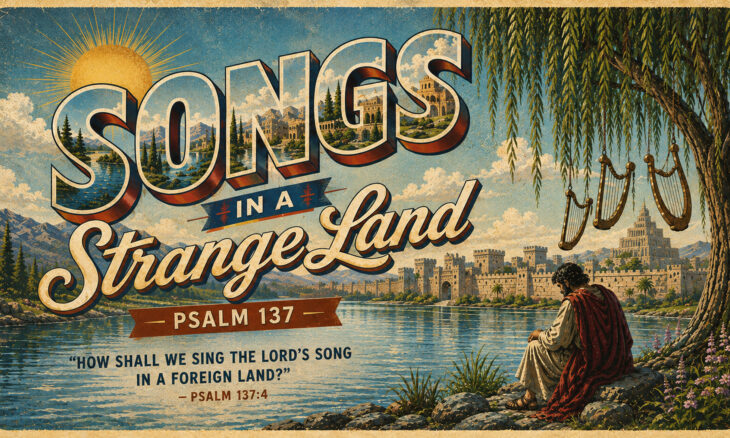
In Psalm 137, the people of Israel ask, “How shall we sing the Lord’s song in a foreign land?”
This is the fundamental question of the believer living in a world that often opposes the values of the Kingdom of God.
Three Ways to Sustain Our Song:
- Remembering: Keep the history of God’s faithfulness at the forefront of your mind.
- Community: Do not sing alone; find harmony with fellow believers.
- Hope: Keep your eyes on the promise of restoration, even when the current landscape is bleak.
Psalm 137:1-2
By the waters of Babylon,
there we sat down and wept,
when we remembered Zion.
2 On the willows there
we hung up our lyres.
I. When the Songs Go Silent
“By the waters of Babylon, there we sat down and wept… on the willows we hung up our lyres” (vv. 1–2)
A: Grief forces us to slow down and think.
“There we sat down and wept” — and they wept when they remembered Zion. The pain wasn’t the land in which they now lived ; it was the home behind them.
Yashab is the word for sitting, but it’s also the word for settling in, dwelling, staying put. Babylon wasn’t a trip it became an address.
- Sitting is what grief does. Job’s friends sat with him seven days before anyone said a word (Job 2:13).
- Ezekiel sat stunned among these same exiles by the Chebar canal for seven days (Ezek. 3:15).
- Jerusalem herself “sits lonely” in Lamentations 1:1.
Zakar — to remember — isn’t nostalgia in Hebrew. It’s the word for covenant recall, the same verb used when God remembers His promises.
Their weeping was theological before it was emotional.
- Same sting we found in 42:4 — remembering the good days can cut deeper than the bad ones.
Two different psalms, one shared ache: the memory of a moment you can’t get back to.
B: The day the music died.
They hung their lyres on the willows.
- The kinnoris David’s instrument, the sound of the temple guild, the strings that carried Israel’s worship for four centuries.
- Those hands still worked. Nobody had anything left to play.
Hanging something up isn’t the same as throwing it away.
- You hang up what you can’t use and can’t part with.
- There are seasons the music just stops, and the instrument sits there in the corner reminding you.
What’s interesting is that the willow branch was the celebration branch.
Leviticus 23:40 put willows of the brook in Israel’s hands for the Feast of Booths — wave them and rejoice. Now the celebration branch is a coat hook for a silent harp.
- For us today its the guitar case in the hall closet after the funeral, the one nobody has opened since
- Or maybe the piano in the apartment with the lid down and mail stacked on it.
B: The World goes on.
Vs 3. For there our captors
required of us songs,
and our tormentors, mirth, saying,
“Sing us one of the songs of Zion!”
Picture where this conversation happens. Babylon in 586 is the largest city on earth
- Canals running everywhere,
- gardens on terraces,
- traders from three continents in the markets.
Somebody’s whole world ended, and Babylon had a good year.
That’s what makes the request so casual.
- To the people asking, this is an evening’s entertainment.
- They’re relaxed. They’ve had dinner.
- Play us something from the old country.
- The catastrophe that gutted a nation is a conversation starter to the people who caused it.
The word behind “mirth” is simchah — festival joy, the joy of a feast day.
They wanted feast-day faces from people remembering the ashes.
Mockery doesn’t always show up as mockery.
- In Psalm 42 the taunt was a question — “Where is your God?”
- Here the taunt is an invitation.
This is a part of grief nobody prepares you for: grief does not stop the calendar.
Jesus said it plainly about the days of Noah and the days of Lot — they were eating and drinking, buying and selling, planting and building, right up to the morning it all came apart (Luke 17:26–28).
The world’s ordinary Tuesday keeps running straight through your worst week.
- You bury your father on a Thursday and the cattle still have to be fed Friday morning.
- Grief doesn’t get you out of chores.
- You walk out of the hospital into rush hour and every single car is honking about something that doesn’t matter, and you want to roll down the window and tell them.
There is a social pressure to perform fine.
The Sunday you walk in gutted, someone asks “how are you?”, and you say “good.”
- We do it in the church foyer.
- We do it at the grocery counter and in the elevator.
- Two syllables and we’re past it.
So the exiles have two choices, and neither one is really appealing:
- Put on the show Babylon is asking for,
- Or go silent and let Babylon think their God is dead.
They’re standing there with the harps still hanging in the branches.
- The verb for hanging up those harps is talah— the same verb Deuteronomy 21:23 uses for a body hung on a tree,
- It’s the verse Paul reaches for in Galatians 3:13.
Israel’s song went silent on a tree, and generations later the Song Himself hung on one.
Have you ever noticed what Jesus did on the night before the cross: Matthew 26:30 says they “sang a hymn and went out to the Mount of Olives.”
He sang the Passover psalms on the way to His own execution
- Then in the garden He told His friends His soul was crushed to the point of death (Matt. 26:38).
- He wept at a tomb He was about to empty (John 11:35).
- He offered prayers with loud cries and tears (Heb. 5:7). ]Our God has sat by the water. He knows the difference between worship and a performance.
And not just any Song either, traditionally they would have sung a song that was a messianic prophecy, Psalm 118.
It contains the famous line: “Give thanks to the Lord, for he is good; his love endures forever.”
But It also features prophetic words about a rejected stone becoming the cornerstone.
In short it was the perfect expression of the attitude we should approach these moments of life with, It expresses deep distress mixed with complete trust in God’s ultimate rescue
Which raises the question:
II. How can we worship here?
“How shall we sing the Lord’s song in a foreign land?” (v. 4)
It’s not “will we sing” — it’s “how can we.” Not rebellion. An honest question.
- Under the law, worship had an address.
- Deuteronomy 12 said sacrifice happens at the place the LORD chooses, and that place was a smoking ruin nine hundred miles west.
- They’re asking a question the Bible itself had raised and never answered.
- The word for “foreign land” is ‘admat nekar — the soil of a stranger. Even the dirt under their feet belonged to somebody else.
- And the “how” they use is ‘eik, the funeral word, the same cry that opens Lamentations. This is a question asked through tears, not folded arms.
A: Worship can’t be manufactured.
- You can’t fake your way to real praise. Performed worship in exile would be a lie — and they refuse to lie, even to their captors.
- The refusal to sing is itself a kind of faithfulness: they love the real thing too much to counterfeit it for Babylon’s amusement.
- There are no rewritten lyrics, no Marduk verse added to make the neighbors comfortable, no quiet edit to help the song go down easier in a new country.
- Babylon can have their labor and their addresses. Babylon does not get the song.
B: Worship became a direction.
Here’s the answer God gave them: “I have been a sanctuary to them for a while in the countries where they have gone” (Ezek. 11:16). Mikdash me’at — a sanctuary in small measure. The building burned. God said, I’ll be the building.
So Daniel opens his windows toward Jerusalem and prays three times a day (Dan. 6:10).
- No altar, no priest, no lamb
- A window and a direction.
- That is worship in Babylon, and it’s strong enough to get a man thrown to lions.
This is where Israel became a people of the Book.
Stripped of the temple, they gathered around the Scriptures and the Sabbath
- By the time Ezra reads the law aloud in Nehemiah 8 the whole nation stands up to hear it.
- What the fire took, the Word replaced.
God would rather have your honest silence than your dishonest song.
And their honest silence became a song; Psalm 137 is a song.
The honest lament is the Lord’s song in a foreign land, and God thought enough of it to put it in the hymnbook.
Worship in exile looks like a window,
- A direction
- a Book,
- a Sabbath,
- a lament.
Four things Babylon could not confiscate. Four things nobody can take from you either.
C: Exile is not the end of the song.
The woman at the well asks Israel’s oldest question.
Hundreds of years later, a Samaritan woman asks the Psalm 137 question differently — which mountain, whose temple, where do we do this?
Her people worshiped on Gerizim, His people in Jerusalem, and that argument was seven hundred years old and had gotten people killed.
- She raises it to change the subject. He’s just named her five husbands and the man she’s living with now, and she reaches for theology the way we reach for the weather.
- Jesus takes the dodge and answers it like it’s the best question she ever asked.
John 4:23
“ But the hour is coming, and is now here, when the true worshipers will worship the Father in spirit and truth, for the Father is seeking such people to worship him.”
Standing in front of her. The hour Israel had been waiting on since the temple burned had a face and was thirsty and was sitting on the edge of a well.
Worship in spirit and truth — deeper than temple worship could ever be!
- Spirit means it comes from the inside out.
- Truth means it can’t be a performance.
That’s the exact thing Babylon demanded and the exiles refused to give.
The address question is finally answered, and the answer is a Person.
- Not a mountain.
- Not a city.
- Not a building with a name on the sign.
HIM
I Love who He tells first…….
- Not the Sanhedrin.
- Not a priest.
- A woman with a reputation, from the wrong nation, drawing water at noon to avoid the neighbors — living in exile inside her own hometown.
The first person to hear that worship has no address is the one person who had no place to stand.
Midnight in a Philippian jail. Two believers sit in a foreign jail at midnight — and sing (Acts 16).
- Paul and Silas sang the Lord’s song in the strangest land of all.
- They’d been stripped, beaten with rods, thrown in the inner cell, feet locked in stocks. Their backs are open. There’s no medical care coming. This is not a good mood.
- Luke says the prisoners were listening.
- Same audience as Psalm 137 — captives, a jailer, men who’d have paid to see the show — except this time the song is real, and nobody had to ask for it.
The earthquake opens the doors and Paul doesn’t run. He stays for the jailer.
- The song was never about getting out; it was about praising HIM in the hardship,
- it was about the man who was going to fall on his knees and ask what he must do to be saved.
Babylon at least had houses and gardens.
This is a stone floor. What changed is that the song now came from a hope no jail could confiscate.
Paul learned midnight singing from Somebody…..
Our world says to wait till you’re home and happy, then you’ll have something to sing about.
Jesus says the song in the strange land is the loudest testimony you’ll ever give.
- Anybody can sing at the harvest.
- Anybody can sing when the tests come back clean.
- The song that stops a prison cold at midnight is the one that comes from a man with nothing left to lose and everything already secured.
Before Israel ever asked how to sing in Babylon, Ezekiel had already watched God leave Jerusalem in stages
- 9:3 — the glory rises from the cherub in the holy of holies and moves to the threshold of the house. He steps off the ark.
- 10:4 — He waits at the threshold. The house fills with cloud, the court fills with brightness.
- 10:18–19 — the glory goes out from the threshold, mounts the cherubim, and stops at the east gate of the temple.
- 11:22–23 — the cherubim lift their wings and the glory goes up from the middle of the city and stops on the mountain east of Jerusalem. That mountain is the Mount of Olives.
Four stops. Ark, threshold, gate, mountain. Every stage moves east — the direction of Babylon, the direction the exiles had been marched, the direction they’d come home from. He faces the ruin He’s leaving the entire way out, and He keeps pausing, like He’s giving them one more chance to notice.
And He said it out loud on the way out: I will be a sanctuary to them in the countries where they have gone (Ezek. 11:16).
The house was being abandoned in the same breath God promised to be the house Himself.
If you check the dates in Ezekiel it’s pretty amazing.
- The glory of God shows up by the Chebar canal in chapter 1, in the fifth year of the exile.
- Ezekiel doesn’t find out it left Jerusalem until chapter 8, a year later.
- They saw Him in Babylon before they knew He’d gone.
- God went to the strange land first.God went to the strange land first.
Christ was born into occupied territory.
- He had nowhere to lay His head.
- He was carried outside the gate to die on ground that was unclean by design.
- Every strange land you’ll ever sit down in has His footprints in it already.
Conclusion
In Ezekiel 43:1–5: the glory returns to the new temple — from the east, through the east gate. It comes back the way it left. Which is worth noting for a series on exile:
So what keeps a heart from going native in exile? Deliberate remembering
- The Word,
- the Table,
- the gathered people,
- the practices that hold the true home in view when your circumstances argue against it.
What keeps a heart from going native in exile? Deliberate remembering
- The Word,
- the Table,
- the gathered people,
- the practices that hold the true home in view when your circumstances argue against it.
Remembering in Hebrew was never a mood. It’s zakar, and it takes a body.
- Israel remembered by keeping a feast,
- building a pile of stones,
- tying words on their hands,
- telling the story to their children at a table.
God knew memory fades unless you give it something to hold onto.
Which is exactly why Jesus, on the night everything came apart, didn’t hand His disciples a doctrine. He handed them bread. Do this in remembrance of Me (Luke 22:19).
The Table is a discipline of remembering for people who live in a strange land and forget too easily.
We are, Scripture says, strangers and exiles here (1 Peter 2:11; Heb. 11:13–16). Our Jerusalem is still ahead — don’t let the strange land talk you out of your citizenship.
Hebrews 11 says they could have gone back. They’d had opportunity. They kept going anyway, because they were looking for a better country — and God was not ashamed to be called their God.
Exile doesn’t usually end your faith with a decision. It ends it with a drift.
- Nobody plans to stop caring.
- You just stop showing up,
- stop opening it,
- stop coming to the Table —
And one day Babylon feels like home and Jerusalem feels like a story your grandmother told you.
The psalm never resolves. It ends on the hardest note in the songbook and just… stops. No tidy bow — because some exiles don’t get tied off this side of home.
- But that it’s a song at all is the quiet miracle.
- They asked “how shall we sing?” — and the how is that they turned the grief and the rage into this.
- The lament itself is the worship. This psalm is a song in a strange land.
So sing anyway. Not a performance, not a forced cheer — the honest song: the tears, the questions, even the anger, all brought to God. That’s the song of the strange land, and heaven leans in to hear it.
One day the exile ends — Babylon falls, the willows give back the harps, and the ransomed come home with singing. Until then, we sing here: strangers, on the way.